
Showing posts with label HWY 78. Show all posts

Thursday, October 11, 2012

Meningitis outbreak highlights failed oversight efforts


FRAMINGHAM, Massachusetts (CNN) — If Sarah Sellers’ warnings had been taken seriously 10 years ago, 12 people might be alive today.
Sellers, a pharmacist and expert on the sterile compounding of drugs, testified to Congress in 2003 about non-sterile conditions she’d witnessed.
“Professional standards for sterile compounding have not been consistently applied,” she told the Senate Committee on Health, Education, Labor, and Pensions. “The absence of federal compounding regulations has created vulnerability in our gold standard system for pharmaceutical regulation.”
Nearly 10 years later, there are still no federal sterility guidelines for compounding pharmacies that make and distribute drugs all over the country.
Now, 137 cases and 12 fatalities nationwide are blamed on a rare, noncontagious form of meningitis linked to contaminated steroid injections made by the Massachusetts-based New England Compounding Center.
The latest death to be connected to the outbreak was that of a 70-year-old man who died in Florida in July, prior to the discovery of the contamination.
Tennessee is the hardest-hit state, with 39 infections and six deaths, according to the Centers for Disease Control and Prevention. Three deaths occurred in Michigan and one each in Maryland and Virginia, the CDC said.
Patients contracted the deadly meningitis after being injected in their spines with a preservative-free steroid called methylprednisolone acetate that was contaminated by a fungus. The steroid is used to treat pain and inflammation.
As many as 13,000 people may have received the medicine between May 21 and September 24, the CDC said.
The New England Compounding Center announced Wednesday it has established a recall operations center to manage the removal of all its products from circulation. Last week, the pharmacy voluntarily surrendered its license to operate until the Food and Drug Administration’s investigation into the contamination is complete.
Health officials say 75 medical facilities in 23 states received the contaminated steroid injections from NECC.
At least two lawmakers are introducing bills to strengthen the FDA’s oversight of compounding pharmacies.
“Unfortunately, compounding pharmacies are a 19th century service operating in a 21st century industry, and we need to update and strengthen the rules that govern these operations so that patients can safely benefit from the unique service they offer,” Rep. Edward Markey, D-Massachusetts, said in a statement. “I look forward to working with my colleagues to introduce this legislation and to ensure FDA has the authority it needs to oversee these pharmacies and protect patients.”
Rep. Rosa DeLauro, D-Connecticut, vowed similar action. “This outbreak and the corresponding recall of products from the New England Compounding Center expose dramatic gaps in our drug safety standards that create an unnecessary risk to the public health,” she wrote in a letter to Health and Human Services Secretary Kathleen Sebelius.
While compounding pharmacies were intended to create customized medications for specific patients, some “have evolved into large scale operations that produce sizeable quantities of some drugs,” she wrote. “For example, cases in the current outbreak are spread across nine states and more than 17,500 doses of the potentially contaminated drug were shipped to 23 states. At the same time, the FDA lacks clear authority for ensuring the safety of these products and last updated its guidance for (the) industry in 2002.”
The FDA has been working on new guidelines since at least 2006, but the effort is “still in progress,” FDA spokeswoman Erica Jefferson said.
Currently, the FDA does not have jurisdiction over compounding pharmacies until there is a problem. FDA officials say they have been fighting to change that for more than 20 years.
The compounding pharmacy industry has challenged those efforts, and courts have ruled that individual state health departments are in charge.
“These facilities are inspected upon initial licensure and in response to complaints,” said Alec Loftus of the Massachusetts Department of Public Health.
Massachusetts requires compound pharmacies to be licensed by the state board, but does not require accreditation. That’s a voluntary process that only 162 out of 3,000 compounding facilities have obtained, according to the Pharmacy Compounding Accreditation Board.
“The oversight appears to be quite lax,” said CNN’s chief medical correspondent Dr. Sanjay Gupta, reporting from Massachusetts about the contaminated drugs. The New England Compounding Center “can distribute thousands of doses of drugs and it doesn’t necessarily have to be accredited.”
The center’s building in Framingham is also home to a garbage compactor and recycling center. CNN observed a medical waste truck making a drop, as well as piles of garbage, boxes, and old mattresses on the back side of the pharmacy compound building. Both companies are owned by the same people.
If the site had been accredited, officials would have examined the facilities and considered whether there are concerns about the site sharing space with a garbage facility, Gupta said.
“Our investigation into NECC and the outbreak with our partners in Massachusetts are ongoing, so I can’t comment directly on how this factors in,” said Jefferson, the FDA spokeswoman.
There is no law that specifies a minimum proximity between a compounding pharmacy and other establishments.
The Massachusetts Department of Public Health has warned the NECC multiple times since 2002 about unsanitary conditions at its facility.
Statutory and regulatory requirements stipulate that compounding can be done only on receipt of a patient-specific prescription, Dr. Madeleine Biondolillo, director of the department’s Bureau of Healthcare Safety and Quality, told reporters Wednesday.
Asked if there had been a violation, she said some organizations may have operated contrary to the licensing regulations, but that is part of the investigation.
Compounding pharmacies were originally created for doctors or pharmacists to make small amounts of custom medications — for example, adding flavored syrup to a cough medicine, or creating a smaller dose for an individual patient if it’s not created commercially.
They’ve grown into a much larger business. Pharmacy compounding accounts for 37 million prescription drugs in the United States each year.
Some compounders ship thousands of custom drugs all over the country. NECC is licensed to distribute to surgery centers and pain clinics in 50 states.
Nearly 10% of drugs administered in the United States come from compound pharmacies, according to a 2003 Government Accountability Office report.
Meningitis is an inflammation of the protective membranes covering the brain and spinal cord. It is usually caused by an infection, frequently with bacteria or a virus, but it can also be caused by less common pathogens, such as fungi in this case, according to the CDC.
Fungal meningitis is very rare and, unlike viral and bacterial meningitis, is not contagious.
Dr. William Schaffner, chairman of the Department of Preventive Medicine at Vanderbilt University Medical Center, told CNN that fungal infections are not usually mild. He said when a fungus invades small blood vessels, it can cause them to clot or bleed, which can lead to symptoms of small strokes.
In addition to typical meningitis symptoms like headache, fever, nausea and stiffness of the neck, people with fungal meningitis may also experience confusion, dizziness and discomfort from bright lights. Patients might just have one or two of these symptoms, the CDC says.
Health officials say any patients who received an injection at one of the facilities beginning May 21 and who began showing symptoms between one and three weeks after being injected should see their doctor right away.
The earlier a patient gets treatment, the more likely he or she will survive.
Patients are treated with anti-fungal medication, which is given intravenously, so patients have to be admitted to the hospital, the CDC said. Patients may need to be treated for months.
The FDA is urging anyone who has experienced problems following an injection with the NECC product to report it to MedWatch, the FDA’s voluntary reporting program, by phone at 1-800-FDA-1088 or online at www.fda.gov/medwatch/report.htm.
CNN’s Danielle Dellorto reported from Framingham; CNN’s Elizabeth Cohen and William Hudson reported from Atlanta. CNN’s Dr. Sanjay Gupta, Josh Levs and Ann Curley contributed to this report.

Drug firm linked to meningitis outbreak may have misled regulators


The specialty pharmacy linked to a deadly meningitis outbreak may have misled regulators and done work beyond the scope of its state license, Massachusetts Gov. Deval Patrick said Wednesday.
Meanwhile, a second pharmacy connected to the New England Compounding Center in Framingham has shut down for state and federal inspection.
The New England Compounding Center made a steroid that was used in injections for back pain that were later found contaminated. More than 130 people in 11 states have been sickened. Twelve have died.
On Wednesday, Patrick told reporters that state and federal agencies "may have been misled by some of the information we were given" by the New England Compounding Center.
The company was licensed to fill specific prescriptions for specific patients but exceeded that, he said.
"What they were doing instead is making big batches and selling them out of state as a manufacturer would, and that is certainly outside of their state license," he said.
Massachusetts U.S. Rep. Ed Markey seized on Patrick's statement, and sent a letter to the U.S. Food and Drug Administration, asking if it believes it was misled by the company.
"This company may have disregarded federal guidelines, and we need to know from the FDA whether the company misled regulatory authorities and if sanctions against the company are available or warranted," Markey said.
A company spokesman declined comment beyond a statement that company officials are focused on cooperating with the investigation. The company has shut down operations, recalled the fungus-contaminated steroid and is cooperating with investigators.
On Wednesday afternoon, the state announced that drug provider Ameridose has agreed to temporarily shut down, pending inspection by state and federal regulators. Ameridose was founded in 2006 by Greg Conigliaro and Barry Cadden, who opened the New England Compounding Center eight years earlier.
Ameridose compounds drugs at one of its two facilities in Westborough, but also provides sterile medication in prefilled oral syringes to about 3,000 hospitals nationwide.
Dr. Madeleine Biondolillo, director of the state's Bureau of Healthcare Safety, said there's no evidence of problems at Ameridose and the state hasn't requested a recall of any Ameridose products.
A pharmacy manager at Ameridose, Sophia Pasedis, has been a member of the regulatory body, the Massachusetts Board of Registration in Pharmacy, since 2004. But the state said she has recused herself from all matters related to Ameridose and the New England Compounding Center.
Compounding pharmacies supply products that aren't commercially available, based on an individual doctor's prescription. Some have grown into larger businesses, operating across state lines and supplying drugs to thousands of hospitals, clinics and physicians.
Biondolillo said the state has reminded Massachusetts pharmacies that compounding can be done only in response to a patient-specific prescription. She said the state is now requiring all compounding pharmacies to sign an affidavit that they are following all regulations.
The state has 1,100 pharmacies that can compound drugs.
Massachusetts last inspected the New England Compounding Center in March in response to a pending complaint unrelated to the outbreak, officials have said. It also inspected the pharmacy in 2011 when it moved operations, and found no problems.
Asked if the state had tried to determine if the company was making large batches of drugs, a possible signal it was operating outside the bounds of its license, Biondolillo said, "Each time we go out and inspect, we're looking at all aspects of the operation."
She didn't give specifics about what the inspectors found in the most recent visit.
In Ohio, the state's board of pharmacy on Wednesday suspended the company's license to distribute in the state, citing evidence that the company's practices presented a danger of serious and immediate harm to others.
As many as 13,000 people received steroid shots from the New England Compounding Center, according to the federal Centers for Disease Control and Prevention.
Compounded drugs have never been reviewed for safety and effectiveness by the FDA. The outbreak has led to calls from lawmakers, including Markey and Connecticut Rep. Rosa DeLauro, to strengthen the agency's oversight over the drugs.

Thursday, July 5, 2012

Tips to Improving Sleep


The condition of your bedroom really matters, for the quality of your sleep as well as your intimate life and your health. Here are my tips for keeping your bedroom in good shape -- or shaping it up, if it's been neglected:
•Invest in your sleep equipment. A good mattress and quality pillows are important investments in your sleep and health. Replace your pillows every year, and invest in a new mattress at least every seven years -- or whenever your body tells you it's time.
•Go cool and dark. Your bedroom climate is important. Most of us sleep better in a cool room. And we all benefit from darkness for sleep. Try an electronic curfew about an hour before bed. Disengage from email, phone, and texting. There's plenty of research that shows how disruptive these devices are for sleep. Better yet, keep them out of the bedroom altogether. If you fall asleep to the TV, use your TV timer so it turns off after you have fallen asleep.
•Fresh sheets are an easy indulgence. Keep fresh sheets on your bed, wash them often, and invest in an extra set so you can change them frequently. As this survey indicates, fresh sheets are a big draw -- they can entice you to bed earlier and help you sleep better once you're there.
•Pamper. Give yourself a sleep vacation at home! Those sleep spa getaways are increasingly popular, but you don't have to leave home to reap the benefits of some sleep-focused down time. Unplug from your regular responsibilities -- and your PDA. Sign up for a yoga class or a local spa visit. Follow up these relaxing activities with an afternoon nap and a quiet evening before bed. And think about adding some of these "indulgences" into your regular routine!

Monday, July 2, 2012

20 Things You Might Not Know About Alcohol


1  Sobering disclaimer: The family of compounds known as alcohols are all toxins that can kill you, whether instantly, quickly, or gradually.
2  Yet one of them—ethyl alcohol, or ethanol—is a staple of the human diet. Archaeologist Patrick McGovernspeculates that fermented beverages were made as early as 100,000 years ago, when people first spread out of Africa.
3  The seeds Johnny Appleseed sold to farmers throughout Ohio and Indiana produced apples that were inedible, but perfect for making hard cider.
4  According to the Drunken Monkey Hypothesis, our zest for alcoholic beverages derives from our distant ancestors’ impulse to seek the ripest, most energy-intensive fruits.
5  Designated driver at the zoo: The Malaysian pen-tailed treeshrew routinely chugs the equivalent of nine glasses of wine a night in naturally fermented nectar, and yet it remains fully functional.
6  For a treeshrew, that is.
7  Fermentation occurs when enzymes, typically produced by yeast, convert sugar molecules in grapes or grains into ethanol.
8  That process can also happen in your digestive system, spiking every 100 ml of blood with 0.01 to 0.03 mg of alcohol.
9  Seriously, officer! Japanese doctors have observed patients with “auto-brewery syndrome,” in which high levels of candida yeast in the intestines churn out so much alcohol that they can cause drunkenness.
10  No digestion required. Ethanol is such a small, simple molecule—just two carbon atoms, six hydrogens, and a spare oxygen—that it pours directly out of the stomach and small intestine into the bloodstream.
11  A lean, muscular person will be less affected by drink than someone with more body fat: Water-rich muscle tissues absorb alcohol effectively, preventing it from reaching the brain.
12  Drunkenness is considered an impairment of the neurons in your head, but Australian researchers recently reported that part of the feeling may result instead from the effect of ethanol on the brain’s immune system. The finding could lead to new treatments for alcoholism.
13  The times they are a-changin’. In 1895 Anheuser-Busch launched Malt-Nutrine, a 1.9 percent-alcohol-content beer prescribed by physicians as a tonic for pregnant women and a nutritional beverage for children.
14  Until 1916 whiskey and brandy were listed as scientifically approved medicines in the United States Pharmacopeia.
15  Drinking and driving: Surplus wine in Sweden is distilled into ethanol, mixed with gasoline, and sold to service stations.
16  Ethanol was widely used as an industrial fuel in America until a tax on alcoholic beverages, levied to help pay for the Civil War, prompted a switch to kerosene and methanol.
17  Methanol, a distillation 
of wood pulp, can destroy the optic nerves. “Blind drunk” was Prohibition-era slang for damage 
caused by drinking grain alcohol that had been cut with methanol by unscrupulous bootleggers.
18  Interstellar brewery: The nebulas where stars form abound with hydrogen, carbon, and oxygen, 
the atomic building blocks of alcohol.
19  Sure enough, astronomers found vast quantities of ethanol—as much as that in 400 trillion trillion beers—
in G34.3, an interstellar cloud some 10,000 light-years from Earth.
20  Resolution for 2012: Don’t stare at the cork. The 
carbon dioxide in champagne bottles creates 90 pounds of 
pressure per square inch, three times the pressure in automobile tires. Flying corks can cause retina detachment, double vision, and blindness. 

Saturday, June 30, 2012

The Importance of Omega-3


People who eat a diet rich in omega-3 fatty acids may significantly lower their risk of developing memory problems and Alzheimer’s disease, a new study has found.
Researchers recruited 1,219 people over age 65, and followed their dietary habits for more than a year.  Then they tested the subjects' blood for a protein called beta-amyloid, a protein is associated with memory problems and Alzheimer’s disease. In fact, plaques and tangles which are found in the brains of Alzheimer’s patients are actually clumps of this substance.

“We know that the amyloid mechanisms are out of control in a person with Alzeimer’s disease,” said the study's lead author, Dr. Nikolaos Scarmeas, associate professor of clinical neurology at New York's Columbia University Medical Center.
“We wanted to see if different nutrients influenced those levels.”
Interestingly, the people in the study who consumed omega-3 had significantly lower levels of amyloid in their blood.
The effects are continuous researchers say.  The levels decreased by 20-to 30% for each gram of omega-3 fatty acid added to their diet.  One gram is equivalent to a handful of walnuts, or half a piece of salmon.
“The more you eat, the lower the amyloid level will be,” said Scarmeas.
The study – published in the medical journal of the American Academy of Neurology - also evaluated beta-carotene, vitamin D, vitamin B12, vitamin E, omega-6, saturated fatty acids, and non-unsaturated fatty acids in the participants diets.
Omega-3 was the only nutrient that showed an association with lower amyloid levels.
A 2010 study found that people who ate food high in omega-3 acids had a nearly 40% lower risk of developing Alzheimer’s compared to people who didn’t.  However, the reason why couldn’t be determined.  Researchers believe this new study may help explain the connection.
Foods rich in omega-3 fatty acids are often the crux of a Mediterranean diet. Choose fatty fish like mackerel, trout, herring, tuna or salmon.  Non-fish options include kale, tofu, soybeans, walnuts and flaxseed.
Although it is best to get nutrients from natural resources, omega-3 supplements can also be effective.  Consult with your doctor before adding fish oil supplements to your diet because they may interact with other medications.

Tuesday, June 26, 2012

Chiropractic Care for Children


Chiropractic is not only safe for children, it’s wise. Chiropractic care can help alleviate the aches and pains that result form a misalignment of the vertebrae. Children also suffer from many types of illnesses, from allergies to injuries, that can cause pain and discomfort. Good chiropractic care for children means a practitioner that has experience working with young spines, adapting their training and chiropractic techniques to allow for examinations and adjustments that are gentle and non-intimidating.
Extremely gentle pressure (applied with fingertips or soft hand thrusts) is the most effective method of chiropractic care for children. By examining the spine, and using gentle, yet targeted pressure, cavitation of the joints eases the tension in the joint and releases pressure in the surrounding tissue. Children respond amazingly fast so those pesky aches and pains will be gone in no time.

Monday, June 4, 2012

For the Busy Mom's Out There

Sometimes moms think sacrificing their own time and health for their family is just what needs to be done, when really their families would work much better with a healthier, happier mom. Plus they’ll be around longer to enjoy their family!


  1. Fit in 10 minutes of exercise where you can. Park far from the store and walk quickly. If you watch TV at night, there are many strengthening exercises you can do that are really easy, including writing the alphabet with your big toe. Do it with both feet and strengthen your ankles and calves.
  2. Schedule in your exercise as an appointment that cannot be rescheduled. Workout for something such as your first race or your first triathlon. Find something that interests you a few months away and start to train for it! It commits you, and makes exercising have a GOAL. You never know, you might just find a new joy!
  3. Get over needing to look put together to go anywhere. If you get to work out in the morning, then have errands to run and can’t fit in a shower until later…oh well! Decide not to let your hair and makeup get in the way of what you need to do for yourself.
  4. Prepare big batches of food! If you don’t like eating the same thing for a few days, freeze the portions needed for your family in your freezer during the week and use them the following week.
  5. Use time management that works for you. Schedule your week so you can stay organized. Start by making a list of all the recurring tasks that happen each week like laundry, cooking, shopping, errands, exercise and bill-paying.  Those can be on set times and days, then add in the one-time tasks or events for the week. Don’t overbook and don’t take out your self -care time! Look at your week on Sundays, make sure you have everything scheduled that you need to get done-including YOUR time for exercise and self-care.

Friday, June 1, 2012

Overcoming Chiropractic Fear


If you have never been to a chiropractor before, it is only natural to have some apprehension on your first visit. If you are suffering from neck or back pain, visiting a chiropractor can alleviate and even eliminate pain, and yet some people are simply afraid to go. This is especially true if you don’t know what to expect. Knowledge is power and getting the facts and understanding what will happen can help you overcome your fear.

Book a Consultation

One of the best things you can do to overcome your fear of the chiropractor is to book a consultation appointment. Make sure when you book the appointment you let them know about your concerns. A good chiropractor will sit down with you and explain to you about chiropractic care, what it is and what will happen during your first adjustment. They will let you know that being adjusted does not cause any pain and in fact relieves it. They should be able to answer any questions you might have and may even have additional brochures or short movies for you to watch.

Ask Friends, Family and Co-Workers About Their Chiropractic Experiences

Another way to help alleviate your fear is to talk to others who have been treated by a chiropractor in the past or who are currently under chiropractic care. They will be able to tell you their stories of chiropractic success and let you know there is nothing to worry about. This is also a great way to get a referral and just knowing you are seeing a chiropractor that has been recommended can help.

Focus On Pain Relief

The most common reason people visit chiropractors is for back or neck pain relief. If this is you, try to stay focused on the pain relief. So many people continually suffer from neck and back pain that could so easily be alleviated and even eliminated through chiropractic care. Especially if you are seriously suffering, in the end, pain relief should outweigh fear.

Tuesday, May 22, 2012

Chiropractic Care Helps Allergies


The next time you sneeze, it may be a good time to visit a chiropractor. Yes, a chiropractor. Most people never think about it, but chiropractic care can help provide allergy relief.
That’s because chiropractic care, often thought necessary for only back and neck problems, can help with keeping the body operating at peak performance. The body’s immune system helps with preventing disease and infection, dealing with stress and overall well being. The immune system also tackles the invasion in a body of foreign substances such as pollution, dust, dead cells, etc. Current research is showing that there is a direct link between the nervous system and the immune system. Chiropractors remove nerve interference and allow the immune system to work optimally.
The immune system is affected by nerves and hormones. An immune system not operating effectively can:
  • Fail to recognize and remove abnormal cells such as those that are cancerous.
  • Be unable to fight infections.
  • Overreact to things such as bee stings, penicillin, certain foods, pollen etc.
  • Become depressed making you more vulnerable to disease.
But just how can chiropractors help with such problems?
The answer is simple, chiropractic care releases stress on a patient’s nervous system. This allows the immune system to operate more effectively, which is beneficial to anyone and especially those suffering from allergies.
The chiropractic approach is to remove subluxations, a term for a misaligned spinal vertebra pinching a nerve. Subluxations place stress on the nervous system. Free from nervous system stress, your body will work more effectively to neutralize the allergy-causing chemicals in your environment.
No matter what disease or condition you have, you can benefit from a healthy spine. Spinal health can be as important for your overall healing as proper nutrition. Are you and your family carrying the vertebral subluxation complex in your spines? Only a chiropractic spinal checkup will tell. A healthy spine can improve your life – see your chiropractor for periodic spinal checkups.

Friday, May 11, 2012

8 Ways to Increase Your Water Intake

By now you probably know that drinking your daily dose of H2O keeps your body running properly, your skin clear and may even help you lose weight.

But there still isn't a set-in-stone answer when it comes to the question of just how much water we need to drink each day. Some people will tell you to drink eight glasses, while others call that "nonsense."Others will tell you to divide your body weight in half and drink that number, in ounces, of water every day. And depending on the weather or your level of physical activity or whether or not you're pregnant, you might need even more than usual.


About 80 percent of our daily water intake comes from beverages, and the remaining 20 percent comes from the foods we eat.
It's true that you don't want to overdo it when it comes to drinking water. It ispossible to drink too much -- and it can be fatal -- but, with half of Americans drinking sugary drinks daily, we think there's still plenty of room for many of us to drink more water.
Here are a few tips to get more H2O:
1. Place a glass of water by your bed and drink it first thing when you wake up in the morning. 
2. Keep a reusable cup or bottle at your desk. When it's empty, go fill it back up. This is also a great way to fit in more steps during the day.
3. If you don't have a desk job or even if you do, toss a water bottle in your bag to sip while you're out and about. 
4. When you sit down to a meal, have a glass or two of water before you eat. A 2010 study found that drinking two glasses of water before meals helped people lose five pounds more than people who did not increase their water intake.
5. If you are the type of person who would rather reach for a sweet sip than plain ol' water, you don't have to cut out juice cold turkey. instead, fill 1/4 of your cup with 100 percent fruit juice and top it off with water or seltzer. 
6. If you find yourself reaching for soda or other drink that isn't 100 percent fruit juice, use that craving as a reminder to grab a glass of H2O. But if you can't quit those bubbles, seltzer counts as water. 
7. Still can't get over the bland taste of water? Use fresh fruit or veggies to flavor your water. Cucumber, lemon, lime, and watermelon are tasty options - and high in water themselves. 
8. Just as keeping a food diary can help you key into what and when you're eating, tracking your water intake can similarly shine a light on where you could fit in more fluids. There's even an app for that! 

Doctor of Chiropractic Atlanta

Wednesday, May 9, 2012

Chiropractic Care and ADHD


You may have been told that chiropractors treat Attention Deficit Hyperactivity Disorder (ADHD). Well, that’s just not the case. Chiropractors don’t “treat” ADHD. But, chiropractic care can definitely help children, and adults too, who suffer from it. The reason why chiropractic treatment is effective is that ADHD is a neurological disorder. Chiropractic manipulations are not only effective in reducing nervous system disturbances in general, but an adjustment can be intentionally directed to stimulate under-active areas of the brain and calm over-active areas as well.

Because a chiropractic approach to ADHD is natural and drug-free, a large number of parents choose chiropractic care over the conventional medical practice of giving children Class 2 psychotropic drugs that have intense side effects including personality changes and permanent alterations in the brain. The vast majority of parents who’ve opted for chiropractic treatment for their children have noted marvelous behavioral changes as a result.

Due to the differences between the manner in which boys and girls use the two hemispheres of their brain, ADHD seems to occur in more boys than girls and, additionally, for the same reason is often more  easily observable in the behavior of boys than of girls. Some of the symptoms that are most prominent include difficulty concentrating and sitting still, lack of ability to control impulsive thoughts and behaviors, easily distracted by noises and activities, constant movement of fingers, hands, arms, feet, or legs.

Quite a few children who manifest ADHD symptoms are hypersensitive to certain foods, such as dairy or gluten products, and sugars and artificial sweeteners. Furthermore, they generally have a hypersensitive reaction to additives in foods, herbicides and pesticides used to grow non-organic fruits and vegetables, and laundry products such as detergents, fabric softeners, and other chemicals. Often, the removal of these environmental agencies can go a long way in reducing ADHDsymptoms.

Checking for spinal anomalies and certain responses to specific neurological tests are part of the thorough examination offered by your chiropractor.

Sunday, May 6, 2012

Rotator Cuff Tear


Rotator Cuff Tear 


A rotator cuff tear is a common cause of pain and disability among adults. A torn rotator cuff will weaken your shoulder. This means that many daily activities, like combing your hair or getting dressed, may become painful and difficult to do.
Acute Tear: If you fall down on your outstretched arm or lift something too heavy with a jerking motion, you can tear your rotator cuff. This type of tear can occur with other shoulder injuries, such as a broken collarbone or dislocated shoulder.

Degenerative Tear: Most tears are the result of a wearing down of the tendon that occurs slowly over time. This degeneration naturally occurs as we age. Rotator cuff tears are more common in the dominant arm. If you have a degenerative tear in one shoulder, there is a greater risk for a rotator cuff tear in the opposite shoulder -- even if you have no pain in that shoulder.

Thursday, April 19, 2012

Where is the Pain Coming From?


If there is warning pain (tissue damage) it is important to find out what tissue is damaged. Examples: pulled muscle, broken bone, heart attack, kidney stone, aneurism, vascular pathology, burn, infection, disc herniation, nerve entrapment, and many, many other conditions. ** Some of these conditions can be life threatening.***


Common Pain Generators for Warning Pain

·         Muscle
·         Ligament
·         Nerve
·         Joint
·         Disc
·         Blood Vessels
·         Organs
·         Skin

Finding the paingenerator or source of the pain is very important. Each pain generator will have a different clinical presentation of pain. Depending on the pain generator the treatment will be different. Please talk with a doctor to determine your pain generator. 

Sunday, April 15, 2012

Definitions of Pain


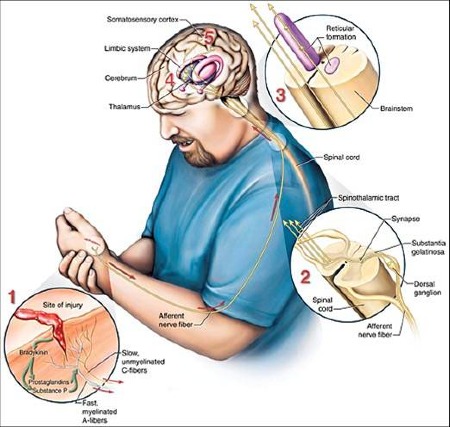
Pain is a universal human experience and the most common reason people seek medical care. In many cases, pain tells us something is wrong, that tissue in our body has been damaged, and we need to do something to change the situation.


Pain – Some definitions you should know:

Algesia: Your sensitivity to pain.

Analgesia: Absence of pain in response to stimulation which would normally be painful.

Hypoalgesia: Diminished pain in response to a normally painful stimulus.

Hyperalgesia: Increased response to a stimulus which is normally painful.

Allodynia: Pain due to a stimulus which does not normally provoke pain.

Pain Threshold: The least experience of pain which a subject can recognize.

Pain Tolerance Level: The greatest level of pain which a subject is prepared to tolerate. 

Thursday, April 12, 2012

Exercises for Back Pain

Back pain relief is the goal of millions of people around the world. Often times it seems to be quite elusive especially when you have everyone telling you how they cured their own problem.  However, I am going to tell you the one simple exercise that works approximately 80% of the time in getting rid of your aches.  I am also going to give you 2 additional tips to speed up your healing.

Tip # 1:
First be sure to always be properly hydrated as dehydration is one of the leading causes of muscle spasms and sciatica. A good rule is to try to drink at least 1 L of water a day. I have even read literature that recommends you to drink 2 to 3 L of water a day. Water is necessary t maintain proper muscle balance and tone and will help get rid of and prevent cramps and Charlie horses.

Tip #2:
Take a daily calcium and magnesium combination multivitamin. This supplement balances the minerals and nutrients in the muscles and not only works as a natural relaxant when you have a problem but it will also help prevent spasms as well.

The main exercise:
The one exercise to relieve your back pain is as follows. Lie on you back and gently move close to a wall and place the heels of your foot on the wall. Start out by having your legs at a 45% angle going up the wall and stretch your arms over your head. You should feel your spine and muscles stretching. As you become more flexible and your pain decreases move your feet up the wall so that your legs are close to a 90% angle. Now this exercise takes some practice so please work your way into this stretch.

Saturday, April 7, 2012

Types of Pain


Types of Pain

Acute and chronic pain, pain caused by tissue damage, pain caused by nerve damage, somatic pain, visceral pain, neuropathic pain, nociceptive pain, radicular pain, headaches, facial pain, peripheral nerve pain, coccydynia, compression fractures, post-herpetic neuralgia, myofasciitis, torticollis, piriformis syndrome, plantar fasciitis, lateral epicondylitis, cancer pain, back pain, neck pain, leg pain, foot pain, etc.

Friday, April 6, 2012

Shoulder Pain


SHOULDER PAIN 

Shoulder pain is an extremely common complaint, and there are many common causes of this problem. It is important to make an accurate diagnosis of the cause of your symptoms so that appropriate treatment can be directed at the cause. If you are unsure of the cause of your shoulder pain, or if you do not know the specific treatment recommendations for your condition, you should seek medical attention. Treatment of these conditions must be directed at the specific cause of your problem.
You should see a doctor if you experience the following:
1. Inability to carry objects or use the arm
2. Injury that causes deformity of the joint
3. Shoulder pain that occurs at night or while resting
4. Shoulder pain that persists beyond a few days
5. Inability to raise the arm
6. Swelling or significant bruising around the joint or arm
7. Signs of an infection, including fever, redness, warmth
8. Any other unusual symptoms

Friday, March 30, 2012

Celebrities and Chiropractic Care


Famous people who use chiropractic care:


Mel Gibson, Joe Montana, Lance Armstrong, Arnold Schwarzenegger, Robin Williams, Denzel Washington, David Copperfield, Whitney Houston, Alec Baldwin, Whoopie Goldberg, Ted Danson, Demi Moore, Macaulay Culkin, Steven Segal, Cher, Jerry Seinfeld, James Earl Jones, Clint Eastwood, Jane Seymour, David Spade, Shirley MacLaine, Madonna, Kenny Loggins, The Eagles, Van Halen, Michael Jordan, Scottie Pippin, Charles Barkley, Atlanta Falcons team, Dallas Cowboys team, Tiger Woods, etc.

Tuesday, March 27, 2012

MRI


MRI

MRI stands for Magnetic Resonance Imaging and it is a test that uses a magnetic field and pulses of radio wave energy to make pictures of organs and structures inside the body.

There are several types of MRIs. There are head MRIs, chest MRIs, blood vessel MRIs, abdomen and pelvis MRIs, bones and joints MRIs, and Spine MRIs.

Bone and joint MRIs check for problems such as arthritis, bone marrow problems, bone tumors, cartilage problems, torn ligaments, torn tendons, or infections. It can also check for broken bones.

Spine MRIs check the discs and nerves of the spine for conditions such as spinal stenosis, disc bulges, and spinal tumors.